
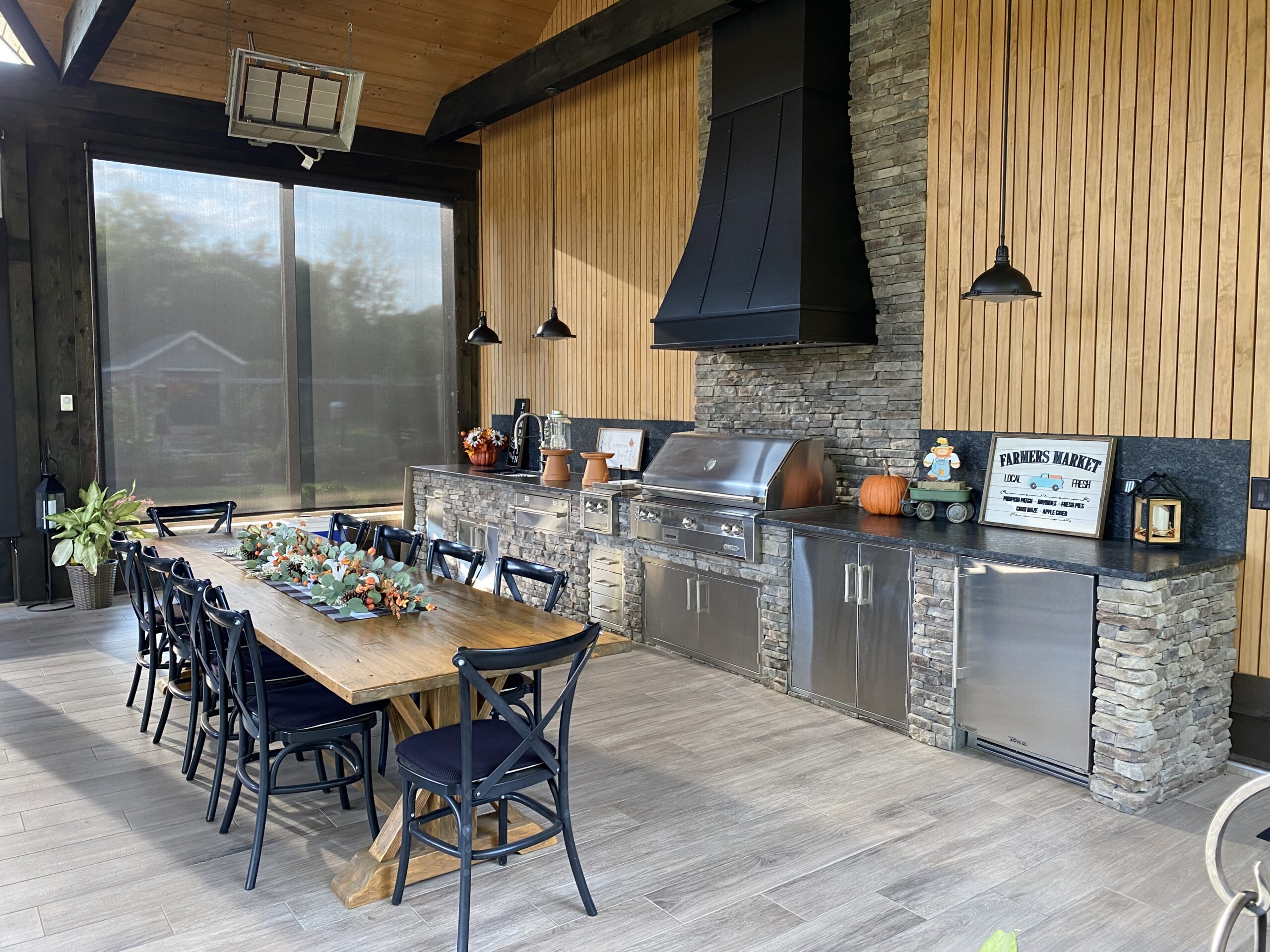
If you’ve spent any time researching outdoor kitchen design ideas, you’ve seen the same generic lists recycled across every home improvement site: built-in grill, mini-fridge, maybe a pizza oven. What those lists skip is how Nashville’s climate changes the equation—sometimes dramatically.
Middle Tennessee is unforgiving to outdoor installations that weren’t built for it. Summers push into the low 90s with humidity between 60 and 80 percent. Winters bring hard freezes, with overnight lows dipping into the upper 20s several times between December and February. A custom outdoor kitchen built to perform beautifully in Scottsdale may fail in Nashville within three seasons if the materials and features don’t account for those swings.
Choosing the wrong features—or the right features in the wrong materials—doesn’t just mean a subpar experience. In Middle Tennessee’s climate, it means a premature rebuild in five to seven years and a wasted investment.
Its for this reason that Nashville area homeowners have started seeking out advice grounded in local expertise, not generic national guides. This guide covers exactly that—outdoor kitchen design ideas that actually work in Middle Tennessee’s climate, drawn from over 20 years of building them here.
Why Feature Selection Matters in Tennessee

Nashville’s climate sits in a humid subtropical zone with a seasonal range that catches many homeowners off guard. July and August bring sustained heat and humidity that accelerates corrosion and degrades gaskets. Then January arrives, and an overnight freeze cracks supply lines and countertops that were never designed to handle it.
That combination is distinct from the dry Southwest, the mild Pacific Northwest, or even coastal Florida, and it’s why recommendations from a national showroom or generic online guide don’t reliably translate to a Wilson County backyard or a Franklin hillside property.
Middle Tennessee demands a different conversation about outdoor kitchen features entirely. Not just what looks good or photographs well, but what holds up through a Tennessee summer, survives a winter freeze, and still performs the way it should five seasons in. That’s the standard every feature on this list is measured against.
The 9 Features Worth the Investment

Not every feature that looks good in a showroom holds up in Middle Tennessee. The nine detailed below are worth the investment because they’re specified for this climate, this humidity, and the way homeowners across the Nashville metro actually use their outdoor spaces.
1. A Built-In Grill — But Not Just Any Grill
The grill is the centerpiece of any outdoor kitchen, but in the Nashville TN climate, grade and configuration matter as much as size.
There are three factors worth understanding before any grill goes on a layout:
- Steel Grade: 304-grade stainless is the standard minimum, but in high-humidity Middle Tennessee, 316 marine-grade stainless offers meaningfully better corrosion resistance, particularly for burner components and drip trays that hold moisture. It’s worth understanding the difference between these materials and discussing with your designer before committing to a unit.
- BTU Output: Most Middle Tennessee homeowners use their outdoor kitchens from March through November. That’s a long, demanding entertaining season, and the grill’s BTU performance should be engineered to handle high-capacity cooking seamlessly.
- Fuel Type: Propane versus natural gas isn’t just a preference decision—it affects island layout. Propane requires tank storage clearances that natural gas installations don’t, and gas line routing requirements differ between Davidson and Wilson counties. This needs to be resolved in the design phase, not on installation day.
2. A Covered Structure (Pergola, Pavilion, or Roof Extension)
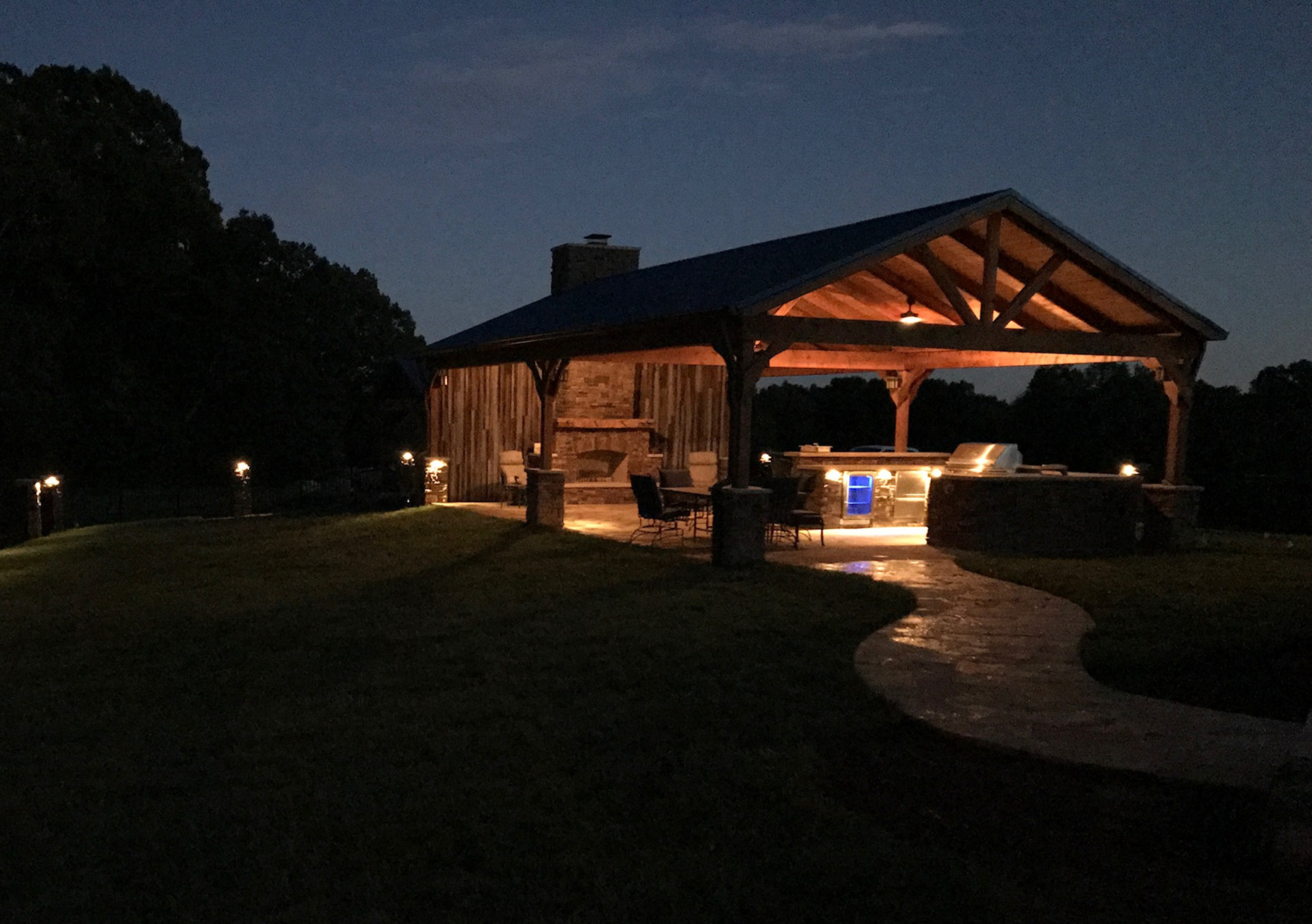
The Nashville metro receives 46 to 48 inches of rainfall annually, per the Tennessee State Climate Office at UTK. An uncovered outdoor kitchen gets rained out regularly from March through May and again in the fall, cutting your usable season well short of what it should be. A covered structure isn’t a luxury; it’s what makes the space functional enough to justify the investment.
There are three main options, and each suit different sites:
- Pergola: Best for larger backyards where a freestanding structure won’t feel cramped, though it offers limited protection from wind-driven rain.
- Attached Roof Extension: Best for homes where the kitchen sits close to the house and architectural integration matters. This option extends the existing roofline for cleaner weatherproofing and a more seamless look.
- Freestanding Pavilion: Best for properties where the kitchen sits away from the house, common on larger lots in Hendersonville and Lebanon.
Permit requirements vary between Mt. Juliet, Brentwood, and Nashville proper. Current thresholds should always be verified with the relevant county building office before plans are finalized, and this check should be a standard step during the design phase of any covered outdoor kitchen design process.
3. Outdoor-Rated Refrigeration
An indoor refrigerator moved outside typically fails within one to two seasons in Tennessee’s heat. The compressor is designed for a narrow ambient temperature range, and Middle Tennessee’s summer highs push well beyond that threshold. When exceeded regularly, it runs continuously, overheats, and fails prematurely—often right in the middle of your busiest entertaining months.
Outdoor-rated units are built for Tennessee conditions; they have sealed compressors, UV-resistant gaskets, and ventilation engineered for ambient temperatures exceeding 90°F.
For sizing, two options cover most Middle Tennessee households:
- Standard 24-inch Undercounter Unit: Handles most entertaining patterns well and fits comfortably into the majority of island layouts.
- 15-inch Undercounter Unit: Better suited to smaller islands or as a secondary unit where space is limited.
Households that host frequently should also weigh a dedicated beverage drawer against a dual-zone refrigerator. The beverage drawer does one thing well; the dual-zone splits capacity between two functions and often under-delivers on both. It’s worth talking through with your designer before settling on a layout.
4. A Stone or Masonry Island Base (vs. Stud-Frame)
The structure beneath an outdoor kitchen matters just as much as the finishes homeowners see. In Middle Tennessee, masonry construction is often worth the additional investment because it handles moisture, temperature swings, and heavy appliance loads more effectively over time.
There are three factors worth considering:
- Moisture Resistance: Wood-framed islands are more vulnerable to moisture infiltration behind cementboard and veneer systems. Masonry construction is far less affected by Nashville’s humid conditions.
- Structural Stability: Built-in grills, refrigerators, and stone countertops place significant weight on an island. Masonry bases handle those loads without the movement that can contribute to cracked finishes or shifting appliance openings.
- Long-Term Performance: Seasonal temperature swings and years of weather exposure place constant stress on outdoor structures. Masonry construction is designed to withstand those conditions for decades.
This approach reflects the same philosophy behind professionally designed hardscaping projects across the Nashville area: build the structure first, then the finishes around it. Rather than functioning as a standalone kitchen unit, the island becomes a permanent part of the outdoor environment.
5. Integrated Outdoor Lighting
Middle Tennessee’s entertaining season runs from March through October, and much of that time is spent outdoors after sunset. Without proper lighting, an outdoor kitchen becomes far less functional during the hours you want to use it most.
There are three lighting layers worth planning for:
- Task Lighting: Illuminates prep areas, cooking surfaces, and steps, improving both safety and usability after dark.
- Ambient Lighting: Creates a comfortable atmosphere in seating and dining areas, extending the use of the space well beyond the kitchen itself.
- Pathway Lighting: Connects the kitchen to the home and surrounding outdoor spaces while improving visibility and navigation.
Landscape lighting is best planned during the design phase, when conduit routing can be coordinated with other electrical work, rather than added later at significantly higher cost. [LINK TO OUTDOOR LIGHTING PAGE]
6. A Side Burner or Warming Drawer
Middle Tennessee entertaining culture leans toward large-group cooking – tailgates, family gatherings, neighborhood cookouts that run for hours and demand more cooking surface than a single grill can handle. Side dishes, sauces, and foods that require lower, more controlled heat often need a separate cooking surface.
- Side burners provide flexibility for everything from sautéed vegetables to sauces while the main grill stays focused on proteins.
- A warming drawer holds finished dishes at serving temperature so everything reaches the table at the same time.
For homeowners who entertain frequently, these additions often prove more useful than larger grills or additional appliance upgrades. For occasional hosts, they’re a lower priority and can be added during a future phase if needed.
7. Outdoor-Grade Countertop Material
In Middle Tennessee, natural stone is the only truly reliable choice for an outdoor kitchen countertop. Materials like granite, quartzite, and bluestone stand up to local conditions best because they naturally resist UV fading and thermal shock. Quartzite, in particular, offers the ideal mix of natural hardness and weather stability, performing well through our seasons when properly sealed.
By contrast, almost every other popular material carries a costly risk in Nashville’s climate. For instance, standard quartz is a frequent problem outdoors because its resin binders yellow under UV rays and easily crack when winter temperatures drop into the 20s. Polished concrete quickly becomes a high-maintenance burden by absorbing southern humidity and staining, while porcelain tile relies on a flawless installation that rarely survives a local freeze-thaw cycle without cracking.
Material selection is one of the decisions Master’s works through during the 3D design phase, before any build begins. Getting it right at the drawing stage costs nothing. Getting it wrong costs a countertop replacement.
8. A Seating Wall Integration
Moveable outdoor furniture weathers poorly in Middle Tennessee—cushions mold, frames corrode, and pieces scatter after every gathering. A built-in seating wall eliminates that maintenance cycle while creating functional flow that loose furniture cannot replicate.
On many Nashville-area properties, seating walls serve a structural purpose as well. In Brentwood, Franklin, and Hendersonville, backyard grade changes frequently require a retaining solution regardless of seating needs. A seating wall that doubles as a retaining element addresses both in a single installation, offering a more efficient, more cohesive, and better looking solution than handling each issue separately. Master’s retaining and seating wall service is regularly scoped directly into outdoor kitchen builds for exactly this reason.
9. A Smart Outdoor Audio Setup (Pre-Wired)
Pre-wiring conduit during construction costs a fraction of retrofitting after hardscape is finished. Trenching and patching completed work is disruptive, expensive, and almost always leaves visible repairs that affect the finished appearance of the space.
This is consistently the feature clients most frequently wish they had added and most frequently defer because the equipment decision feels non-urgent. The fix is simple: commit to the conduit during construction and finalize equipment choices later.
The 3 Features That Rarely Deliver in Tennessee
1. Dishwashers
An outdoor dishwasher isn’t wrong for every homeowner, but it’s wrong for most. In Middle Tennessee, dishwashers require winterization each season, add plumbing complexity, and see infrequent use in most residential installations. The right candidate for an outdoor dishwasher is a high-volume entertainer running large events multiple times per week. For the average household, the winterization and maintenance burden outweighs the return.
2. Elaborate Misting Systems
Misting systems are a common upsell from national suppliers whose products were developed for drier markets. They belong in arid climates like Arizona and Nevada, where low ambient humidity means a fine mist produces genuine evaporative cooling. Middle Tennessee is not that climate. With humidity regularly above 70 percent through June, July, and August, a misting system adds moisture to an already damp environment. The result is a clammy seating area, not a cool one.
3. Sink Setups Without Proper Winterization Planning
A sink is a useful addition when installed correctly. Without a shutoff and drain-down valve, supply lines will freeze and crack during the 25 to 30°F overnight lows Middle Tennessee sees several times each winter. The repair — cutting into the island, replacing runs, patching finishes — costs far more than proper planning would have upfront. Plan for it correctly or skip it entirely.
Planning Your Outdoor Kitchen in Nashville: The Next Step
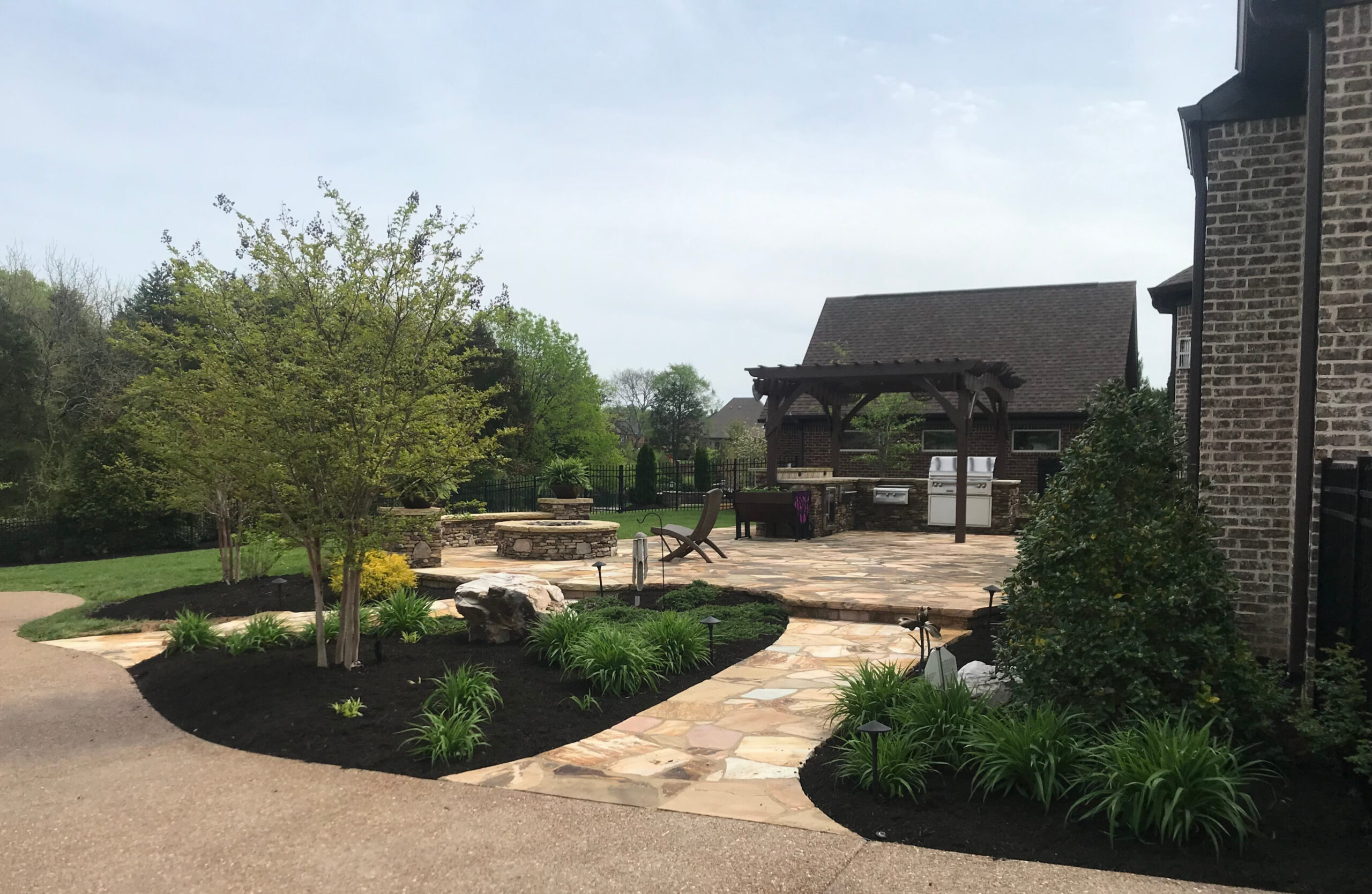
The right outdoor kitchen design ideas only produce lasting results when the design process behind them is equally sound. The features on this list, if built from the wrong materials or placed in the wrong configuration for Middle Tennessee’s climate, still produce a disappointing outcome.
Master’s Landscape Design works through every important decision—material selection, feature placement, structural approach, and site-specific conditions—using a 3D design and rendering process before construction begins. Clients see exactly what they’re building before a single block is laid. No surprises, no mid-project corrections.
For a better understanding of the complete planning process, read our guide on how to plan an outdoor kitchen in Nashville. When you’re ready to move forward, Master’s serves Mt. Juliet, Brentwood, Franklin, and the entire Nashville metro. Call (615) 675-6795 or Request a Consultation to get started.
Summary:
Planning an outdoor kitchen in Nashville means designing for a climate most national guides ignore—humid summers, cold-snap winters, and 46–48 inches of annual rainfall. This guide covers the 9 features that hold up in Middle Tennessee, from masonry island bases and covered structures to outdoor-rated refrigeration and pre-wired audio. It also covers the 3 features that consistently underperform in this climate. Every recommendation is grounded in local conditions, not generic advice.